· I'mBoard Team · governance · 9 min read
Board Management Software Comparison 2026: Price, Fit and Contract Terms
A side-by-side comparison of the major board portals in 2026 -- who publishes pricing, what each really costs, the contract terms nobody reads, and which one fits a startup board.

Comparing Board Management Software in 2026
Most comparison articles in this category are feature checklists. Feature checklists are close to useless here, because every major board portal does agendas, documents, minutes and permissions — and the things that actually decide whether a purchase was a good one are price transparency, seat definitions and contract terms.
Quick Answer: Of the major board portals in 2026, only three publish a price: I’mBoard ($30/seat/month, 3-seat minimum), Boardable and BoardPro. Zeck, OnBoard, BoardEffect, Diligent, Nasdaq Boardvantage, Govenda (an OnBoard brand since 2024), Convene and Aprio are all quote-only. Actual transaction data puts Diligent’s median annual contract in the mid-five figures, while startup-focused tools run roughly $1,000—$5,000/year. The biggest avoidable cost is not the subscription — it is the default contract term.

The Comparison Table
| Platform | Price published? | Typical annual cost | Built for | Free trial |
|---|---|---|---|---|
| I’mBoard | Yes — $30/seat/mo, 3-seat min | ~$1,080/yr at 3 seats | Venture-backed startup boards | 14 days, no card |
| BoardPro | Yes — per board/mo, unlimited users | ~$1,650—$4,400/yr per board | SMEs, nonprofits | 30 days, no card |
| Boardable | Yes — per user/mo, billed annually | ~$250—$430 per user/yr | Nonprofits | 14 days, no card |
| Zeck | No | Not published | Startup CEOs and boards | No |
| OnBoard | No | Estimated $5,000—$15,000/yr | Associations, finance, healthcare, higher ed | By request |
| BoardEffect | No | Estimated $5,000—$15,000/yr | Nonprofit, healthcare, higher ed | None advertised |
| Convene (Azeus) | No | Not published | Nonprofits, banks, credit unions | Sales-gated |
| Aprio Boardroom | No | Not published (20-user license floor) | Credit unions, banks | 3 months risk-free |
| Nasdaq Boardvantage | No | Not published | Public companies, banking | No |
| Diligent Boards | No | Median ~$25,000/yr; enterprise $100,000+ | Enterprise, public companies | Not advertised |
The $5,000—$15,000/year figures for OnBoard and BoardEffect are market estimates, not vendor-published rates — widely repeated, but with no primary source behind them. We label them as estimates rather than dressing them up as facts. The Diligent figures are different: they come from aggregated real purchase data across dozens of transactions, with a median around $25,000/year and a range from roughly $5,500 to $48,000. Small boards buying the Boards module alone land in the $15,000—$35,000 band; enterprise deployments with the full suite reach six figures.
Note also that only 3 of 10 vendors here will tell you a number without a call — and hidden pricing recurs as a complaint across the review profiles of the vendors that don’t.
What to Actually Compare
Buyers in this category consistently rank the same capabilities as critical. Capterra’s board management software buyers guide puts meeting management at 96% of buyers rating it critical or highly important, secure data storage at 93%, document management at 90%, access controls and permissions at 87%, and minutes management at 75%. Every serious portal clears that bar. So use those as a pass/fail gate, and spend your evaluation time on the criteria below, which is where the vendors genuinely differ.
Seat definition. Does an admin consume a seat? Does an observer? Does your EA? This is the single most common way a quoted price turns out to be half the real one.
Which tier holds minutes. In more than one portal, the minutes module sits a tier above entry. OnBoard puts Minutes Builder, voting and eSignatures in Premium; BoardEffect puts Minutes in Plus. If minutes is why you are buying, price the tier that has it.
Add-ons versus included. OnBoard marks its AI Suite, SSO, skills tracking and board assessments as add-ons on lower tiers. A base-tier quote is not an all-in number.
Security posture. SOC 2 Type II, ISO 27001, SAML or OIDC SSO, MFA, and an immutable audit trail. Ask whether SSO costs extra — it frequently does.
Offline access. Directors read board packs on planes. This is thinly covered in most buyer guides and worth testing directly.
Implementation and training. For enterprise platforms these are separate line items, often five figures on their own. For self-serve products they are zero.
Contract terms. Covered next, because they deserve their own section.

The Contract Terms Nobody Reads
This is the most expensive part of a board software decision and it is almost never in a comparison article. Diligent’s general terms and conditions are a useful worked example, because they are published and because they represent the enterprise end of this category. As published on diligent.com and retrieved on 19 July 2026, those terms state:
- Fees are annual and prepaid, and on cancellation or termination all monies paid, due or owing are deemed non-refundable.
- Where the agreement does not state otherwise, the initial term is three years and the renewal term is also three years.
- Auto-renewal applies unless you give written non-renewal notice 30 days prior — so a three-year deal can roll silently into another three-year term on a missed email.
- Renewal price increases are not capped, with 60 days’ notice; the choice is accept or exit.
- Seat counts carry forward at full quantity unless reduced in writing 30 days ahead.
- Late payments accrue 1.5% per month — 18% a year — plus attorney’s fees.
Terms are of course negotiable, and these are defaults rather than what every customer signs. But for context, negotiated enterprise SaaS commonly runs 60—90 day notice windows with renewal increases capped at CPI or around 5% — so in our reading these defaults sit at the harsher end of the market, and the gap between default and negotiated is exactly the gap worth spending an hour on.
Other terms worth asking about: Boardable requires 30 days’ notice with changes taking effect at renewal; reviewers across several vendors report meaningful year-over-year increases, and at least one reviewer reports a four-figure cancellation fee for missing an OnBoard notice window.
The practical takeaway: before any demo, ask for the standard terms document. Initial term, renewal term, notice window, escalator cap. Those four fields will tell you more about total cost than the feature matrix will.
What Reviewers Complain About, by Vendor
Ratings in this category cluster between 4.4 and 4.8, so the averages do not discriminate. The complaint patterns do. Everything below is reviewer sentiment reported on public review sites, not our own testing:
- Diligent — reviewers cite a dated interface, cost prohibitive for smaller organizations, hidden pricing, reduced support availability, and a perception of under-investment in acquired products.
- OnBoard — reviewers describe pricing as high and confusing, notification settings that email-blast the whole board, and slow uploads or formatting breakage on large files. Capterra rating is 4.7 across 1,058 reviews.
- BoardEffect — reviewers report slower support responsiveness and account-manager turnover following the Diligent acquisition, unintuitive navigation, and downtime they say arrived without notice. Capterra 4.4 across 127 reviews, with value for money at 4.2.
- Boardable — reviewers report glitchy built-in video, minutes that are not searchable, poor default PDF rendering, and USD-only billing. Capterra 4.7 across 128 reviews.
- BoardPro — reviewers cite limited customization, no anonymous or weighted voting, and no dedicated Android app.
- Nasdaq Boardvantage — reviewers cite an outdated interface, a steep learning curve, and Outlook and Teams sync issues.
- Convene — reviewers cite cost at scale, slow support, and PDF performance lag.
- Zeck — reviewers cite a learning curve on the AI features, and note it lacks depth for larger organizations.
Which One Fits a Startup Board
Strip out the vendors built for volunteer boards, hospital systems and public companies and the list gets short quickly. A Seed-to-Series-B board is three to seven people, two of them investors, meeting quarterly, administered by the CEO personally.
That profile wants: a price you can see, a trial you can start, setup measured in minutes, and no contract to escape from.
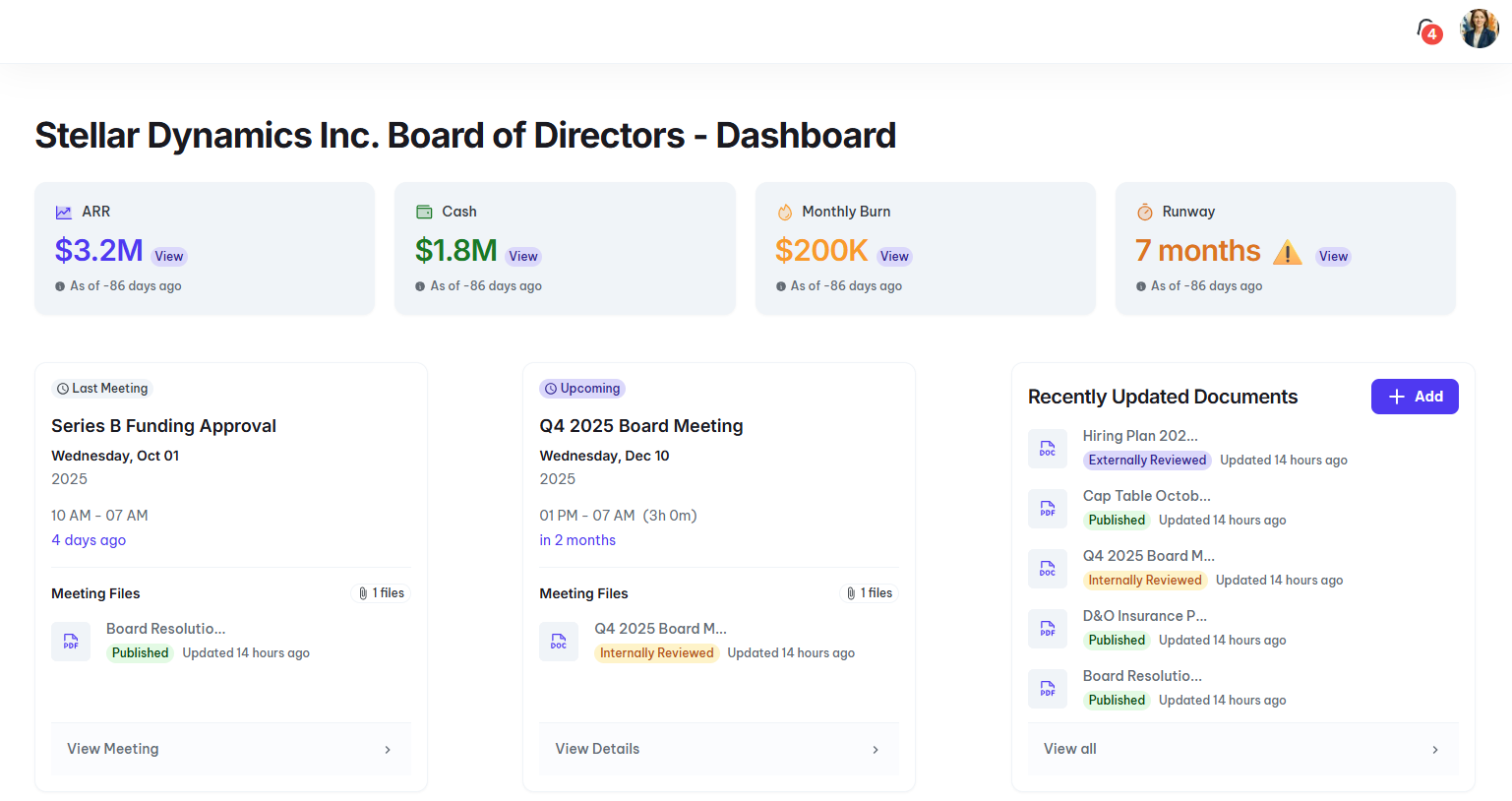
I’mBoard is $30/seat/month with a 3-seat minimum — $90/month, published, month-to-month available. The 14-day trial needs no credit card and no call. Included in the seat price: AI meeting preparation and agenda building, AI-generated minutes with action tracking, digital voting and resolutions with an audit trail, KPI dashboards for between-meeting visibility, investor update workflows, document management with version control, and engagement tracking on who reviewed materials before the meeting. No setup fee and no implementation project.
If your board is a 20-person volunteer body with standing committees, buy something built for that — BoardPro and Boardable are good, transparent products, and OnBoard has two decades of institutional fit. If your board is an investor board, the fit case matters more than the feature grid.
Want to compare it against your current setup? See I’mBoard pricing or start a 14-day free trial — no credit card, no sales call.
FAQ
How much does board management software cost per year?
It depends almost entirely on which segment you are in. Startup-focused tools run roughly $1,000—$5,000/year — I’mBoard is about $1,080/year at three seats. Mid-market portals like OnBoard and BoardEffect are commonly estimated at $5,000—$15,000/year, though neither publishes a rate. Enterprise platforms are higher: aggregated purchase data puts Diligent’s median around $25,000/year, with full-suite enterprise deployments passing $100,000.
Which board management software publishes its pricing?
Only three of the major portals: I’mBoard, Boardable and BoardPro. Zeck, OnBoard, BoardEffect, Diligent, Nasdaq Boardvantage, Govenda and Convene all require a demo before quoting, as does Aprio. Govenda — an OnBoard brand since the May 2024 acquisition — at least discloses that it charges for unlimited users with no implementation fee, and Convene discloses a per-user annual model, but neither publishes a number.
What is the difference between a board portal and board management software?
In practice, nothing — the terms are used interchangeably. “Board portal” is the older, more institutional term and tends to signal a document-repository heritage; “board management software” is the broader modern label covering agendas, minutes, voting, tasks and reporting. Vendors use whichever fits their positioning.
Is board management software worth it for a small startup board?
At the startup tier the arithmetic is simple. $90/month is roughly an hour of a founder’s time. If assembling board packs, chasing approvals and writing minutes consumes more than an hour a month, the tool has already paid for itself — and the recordkeeping value shows up again at your next diligence process.
What security certifications should a board portal have?
SOC 2 Type II and ISO 27001 are what mature vendors in this category hold, alongside SAML or OIDC single sign-on, multi-factor authentication, granular role-based permissions and an immutable audit trail. Weight them against your stage: a public-company board should treat the certifications as non-negotiable, while a seed-stage board is usually better served asking concrete questions about encryption, access control and data handling than about a certificate. Either way, ask whether SSO is included or a paid add-on — at several vendors it sits in the top tier.
Can you cancel a board portal contract mid-term, and what notice is required?
Usually not without forfeiting prepaid fees. Enterprise terms in this category commonly treat annual prepayments as non-refundable, default to multi-year initial and renewal terms, and require written non-renewal notice 30 days before the term ends. Get the initial term, renewal term, notice window and any escalator cap in writing before you sign.
Why do most board portals hide their pricing?
Because they sell through demo-gated, account-executive-led motions, and that headcount is paid for out of every contract. A vendor staffing reps and AEs cannot profitably sell a $1,000-a-year product, so the price floor rises and the figure comes off the website. Vendors that sell self-serve publish theirs. We unpack the argument in detail in our Zeck pricing analysis.
Part of our Startup Governance Guide — a comprehensive resource on corporate governance for startups.