· I'mBoard Team · governance · 12 min read
Zeck Alternatives for Nonprofit Boards: What It Is, What It Costs, What Else to Weigh
Zeck is a deck-first portal for company boards, and it doesn't publish a price. Here is the honest answer for a nonprofit board — plus the portals a 501(c)(3) would actually compare, including the free ones, with a 15-member cost table.
If you searched “Zeck alternative,” you probably hit the same two walls everyone hits: you could not find out what Zeck costs, and you could not tell whether it does what your board actually needs. This page answers both honestly, and then does the more useful thing — puts the options a nonprofit board would really weigh next to each other, free ones included.
What Zeck is, and who it is for
Zeck is a board portal built around the board-update document: polished, interactive materials that replace a static slide file. It adds a pre-vote feature for routine approvals ahead of a live meeting and auto-generated minutes. It sells through referral networks rather than self-serve signup, and its pricing is not published — you fill in a “Request Pricing” form and book a demo to get a quote.
Zeck is aimed at company boards, not nonprofit governance. It is not sold into the 501(c)(3) market, it does not advertise a nonprofit price, and its product story is built around the update format rather than around consent agendas, quorum, committee structures, and a minutes archive an auditor can follow. If Zeck surfaced in your search for board software and you run a nonprofit, that is a search-result coincidence, not a shortlist. We are not going to invent a nonprofit angle for it.
Its reviews are strongly positive and almost entirely about the design of those update documents. What no review can tell you is the price, because there is no published figure to quote. We walk through why in the Zeck pricing breakdown — and we do not guess at a number there either.
Why a nonprofit board goes looking for an alternative
The reasons repeat across the sector, and almost none of them are about features:
- Per-member pricing punishes volunteers. A 15-director board is 15 seats, and most of those directors open the board packet a handful of times a year. Paying a monthly seat fee for each of them is hard to defend to a finance committee.
- Annual-only billing drags a small purchase into a board vote. Under most spending policies an executive director can approve a modest monthly charge alone; a 12-month contract can trigger a board-approval rule the dollar amount never would.
- The features you actually want sit in the top tier. Voting, minutes e-signing, and AI are common upsell levers, so the plan you priced is not the plan you need.
- Demo-gated pricing burns an hour before you can rule anything in or out. Quote-on-request usually travels with annual or multi-year terms, auto-renew clauses, and a cancellation notice window you have to go looking for.
- Adoption fails quietly. “Only half our board adopted it” is the most common post-purchase complaint in the sector. The least technical director decides your real usage rate, not the most enthusiastic one.
- Data can become a hostage. One published review of another portal describes a nonprofit’s board files being deleted after it declined to renew. Ask every vendor what leaves with you, and get it in writing.
The options a nonprofit board should actually compare
All figures below are list prices published by each vendor as of September 2026. Where a vendor does not publish, the table says so rather than guessing.
| Option | Pricing model | 15-member board | Free trial | The catch |
|---|---|---|---|---|
| Zeck | Not published — quoted after a demo | Not published | No self-serve trial visible | Built for company boards; no nonprofit price, no public rate |
| I’mBoard — verified nonprofit | Flat per board, monthly | $888/yr ($74/mo) | Until after your next board meeting, up to 60 days, no card | Requires EIN verification of 501(c)(3) status |
| I’mBoard — standard | Flat per board, monthly | $1,788/yr ($149/mo) | Until after your next board meeting, up to 60 days, no card | Younger product than the enterprise portals |
| BoardSpace | Flat base for boards up to 18 directors, monthly | $1,068/yr ($89/mo base); $1,560/yr with one committee ($130/mo) | None — 60-day money-back on annual instead | Every committee is a separate $41/mo line, so cost grows with your structure |
| BoardPro | Tiered plans per board, monthly available | $1,980/yr ($165/mo list); subcommittees +$82.50/mo | Not published as a no-card trial | Nonprofit discount of up to 40% is annual-locked; voting, minutes e-signing, and AI are not in Essentials — Premium is $275/mo list |
| Boardable (paid) | Per member, billed annually | ≈$3,778/yr ($20.99–$35.99 per user per month) | — | Annual-only invoicing for the full term; declines nonprofit discounts (“already tailored for nonprofits”) |
| Boardable Core | Free tier | $0 | — | Capped at 50 documents and 3 groups; not advertised on their pricing page |
| Societ “My Board View” | Free | $0 | — | Genuinely free and genuinely bare-bones |
| Email + a shared drive | Free | $0 | — | The 100-page packet nobody reads, minutes that take a week, bylaws gone with a departed volunteer’s account |
The enterprise portals — OnBoard, BoardEffect (Diligent’s nonprofit product), Diligent Boards, Govenda, Convene — all belong in the “not published, quoted on request” row alongside Zeck. See OnBoard pricing, BoardEffect pricing, and Diligent pricing for what each one publishes and what it doesn’t. OnBoard’s advertised nonprofit discount requires a multi-year contract with auto-renew, which is worth knowing before the call rather than after.
What to check before you shortlist anything
Five questions settle most of these decisions faster than a feature matrix:
- Are committees included, or billed separately? A finance committee and a governance committee are not optional for most boards.
- Can we pay monthly? This is a governance question as much as a budget one — it determines whether the ED signs alone or the board votes.
- Is there a nonprofit price, and what are its terms? A discount locked to an annual plan is a contract, not a discount.
- What happens to our minutes and bylaws if we leave? Get the export answer in writing.
- Does every director need an account? This is where adoption lives or dies.
Where I’mBoard sits, stated plainly
I’mBoard is one option on that table, not the verdict. Here is what it is:
- $149/month flat per board, or $74/month for EIN-verified 501(c)(3) nonprofits — exactly 50% off, every month.
- Every director and every committee included. No per-seat math for a 15-person nonprofit board.
- Monthly billing, cancel anytime, no auto-renew.
- Free until after your next board meeting (up to 60 days), no credit card.
- Your records are yours — ask and we’ll send you a full export of your archive.
The 15-member math: a verified nonprofit board with 15 directors pays $888/year. A standard board pays $1,788/year. Framed the way a finance committee will hear it, that is roughly what one contested grant report costs in staff hours.
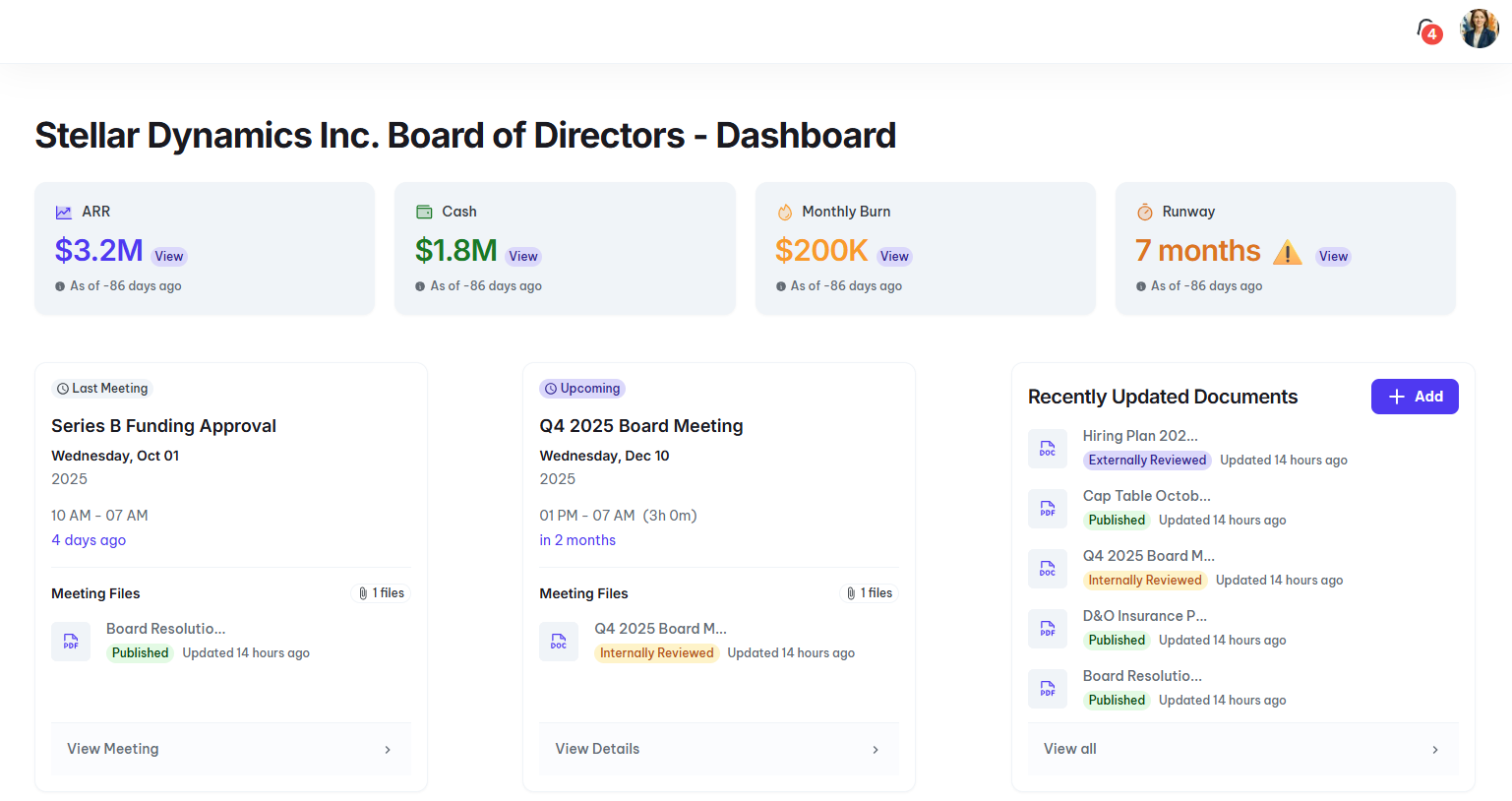
What it does today, without embellishment: board packets you build, distribute, and share with directors, who sign in with Google or a one-time emailed code — no passwords; meeting scheduling; decisions and action items recorded during the meeting; minutes finished while the meeting is fresh and filed into a searchable archive rather than sitting in a volunteer secretary’s drafts for six weeks; AI narrative drafting inside the packet so the ED’s report starts from something instead of a blank page; read tracking so you know who opened the packet; a REST API, CLI, and MCP server for boards whose operations staff want them; and a live demo with no signup.
See it on your own board. Start free — no card — free until after your next board meeting (up to 60 days), no card, no contract. Or view the published pricing first.
Who should choose which
- Zeck — a company board whose main need is a beautiful, interactive board update, that is comfortable with a sales-led process and a price it learns on a call.
- Boardable Core (free) — a small board with modest document volume that wants to stop emailing attachments and can live inside 50 documents and 3 groups.
- Societ “My Board View” — an all-nonprofit board with no budget line at all, that needs somewhere central for materials and nothing more.
- BoardSpace — a nonprofit board that wants an established portal with a simple base price and can absorb a per-committee fee, and does not mind evaluating without a trial.
- BoardPro — a board that wants a mature, well-known product and is willing to sign annually to get the nonprofit rate, with the top-tier price in view if voting or e-signing matter.
- Boardable — a board with a small roster and a preference for a widely used, nonprofit-focused platform, that can budget annually and does not need a discount.
- The enterprise portals (OnBoard, BoardEffect, Diligent) — larger institutions with compliance requirements, procurement staff, and the appetite for a demo cycle and a multi-year term.
- I’mBoard — a nonprofit board of 5 to 15 volunteer directors where the ED assembles the packet, that wants committees included, a published price, monthly billing, and a real trial before deciding.
- Email plus a shared drive — honestly, a brand-new board holding its first three meetings. It stops working the first time someone needs last year’s minutes.
For the full landscape across every tier, see the board management software comparison and the pricing guide. If budget is the binding constraint, the free board software guide covers exactly where each free option runs out. Boards specifically weighing the nonprofit-focused vendors can compare Boardable alternatives and BoardEffect alternatives.
FAQ
What does board management software cost a nonprofit board?
It depends on the pricing model far more than the sticker. Among vendors that publish rates: Boardable is $20.99–$35.99 per user per month billed annually, roughly $3,778 a year for a 15-member board; BoardPro lists $165/month per board with subcommittees at $82.50/month extra and a nonprofit discount of up to 40% locked to an annual plan; BoardSpace is $89/month for boards up to 18 directors with all features and no feature gating at that price, plus $41/month for each committee. I’mBoard is $149/month flat per board, or $74/month for EIN-verified 501(c)(3) nonprofits — $888 a year for a 15-member board, every director and committee included, billed monthly with no auto-renew. Free options exist too: Boardable’s Core tier is capped at 50 documents and 3 groups, and Societ’s My Board View is free and bare-bones.
How much does Zeck cost?
Zeck does not publish pricing. You submit a “Request Pricing” form and book a demo to receive a quote. Directory sites carry no verified rate either, so any specific Zeck figure you find online is unsourced. See the Zeck pricing breakdown for what is publicly known.
Is Zeck a good fit for a nonprofit board?
It is not built for one. Zeck is aimed at company boards, its strength is the board-update document rather than nonprofit governance workflow, and it does not advertise a nonprofit price. If you run a 501(c)(3), compare portals that publish a rate and sell to your sector.
Which board portals offer a genuinely free trial?
Fewer than you would expect. I’mBoard’s trial runs until after your next board meeting, up to 60 days, with no credit card. BoardSpace offers no free trial — it substitutes a 60-day money-back guarantee on an annual plan, which means paying first. Zeck advertises no self-serve trial. If you cannot test a portal on a real board meeting before committing, you are buying on a demo.
Is flat pricing better than per-member pricing for a nonprofit board?
For most nonprofit boards, yes — because the cost of a per-member plan grows with the thing you are trying to grow. Recruiting three new directors should not raise your software bill. Per-member pricing makes more sense for a small board that expects to stay small; flat per-board pricing makes more sense for a 10-to-20-director nonprofit board with committees.
What happens to our minutes and bylaws if we leave?
Ask every vendor and get the answer in writing before you sign — one published review of another portal describes a nonprofit’s board files being deleted after it declined to renew. I’mBoard’s answer: your records are yours — ask and we’ll send you a full export of your archive.
Do all our directors need accounts?
With most portals, yes, and that is where adoption dies. With I’mBoard there are no passwords: directors sign in with Google or a one-time code emailed to them, so reading the materials never requires remembering a password. That matters more than any feature comparison, because a portal half your board never opens is worse than the email thread it replaced.
Can we get a nonprofit discount?
It varies more than you would hope. I’mBoard is 50% off every month for EIN-verified 501(c)(3) nonprofits, with no annual commitment attached. BoardPro offers up to 40% off but locks it to an annual plan. OnBoard’s advertised nonprofit discount requires a multi-year contract with auto-renew. Boardable declines nonprofit discounts on the grounds that its pricing is already tailored for nonprofits. Always read the term attached to the discount, not just the percentage.
Glossary
Board portal: Software for preparing board meetings, distributing materials, and keeping the governance record. It replaces email-based document sharing with one central, searchable place.
Board packet: The complete set of materials sent to directors ahead of a meeting — agenda, consent agenda, financials, the executive director’s report, and any items up for a vote.
Consent agenda: A single bundled motion covering routine items — prior minutes, standard reports, committee updates — approved in one vote so meeting time goes to the items that need discussion. Any director may “pull” an item out for separate debate.
Quorum: The minimum number of directors, set by your bylaws, who must be present for the board to transact business. In most states hybrid and video attendance counts toward it.
Minutes: The official record of what the board decided — motions moved, seconded, and carried, and the resolutions adopted. Not a transcript, and not an informal jotting; minutes are approved at the following meeting and become part of the permanent record.
Executive session: A portion of a meeting closed to staff and guests, typically for personnel, legal, or compensation matters. Its existence is minuted even though its content is not.
Unanimous written consent: A decision taken without a meeting, where every director signs a written resolution. Your bylaws and state law set when it is available.
EIN verification: Confirming a 501(c)(3)‘s Employer Identification Number to establish tax-exempt status — the check behind a verified nonprofit rate.
Part of our Nonprofit Board Portal resources — pricing, the honest comparison including the free options, and how the verified-nonprofit half price works.